Exploring Swayambhunath Temple: Kathmandu’s Timeless Monkey Temple
Swayambhunath Temple is a perfect example of spirituality meeting everyday life. This iconic world heritage site is not just a sacred site, but part of the community where daily activities and spiritual beliefs coexist in harmony. Swayambhunath temple stands tall above the forested hill as a guardian looking over the entire Kathmandu Valley with its wisdom eyes compassionately.
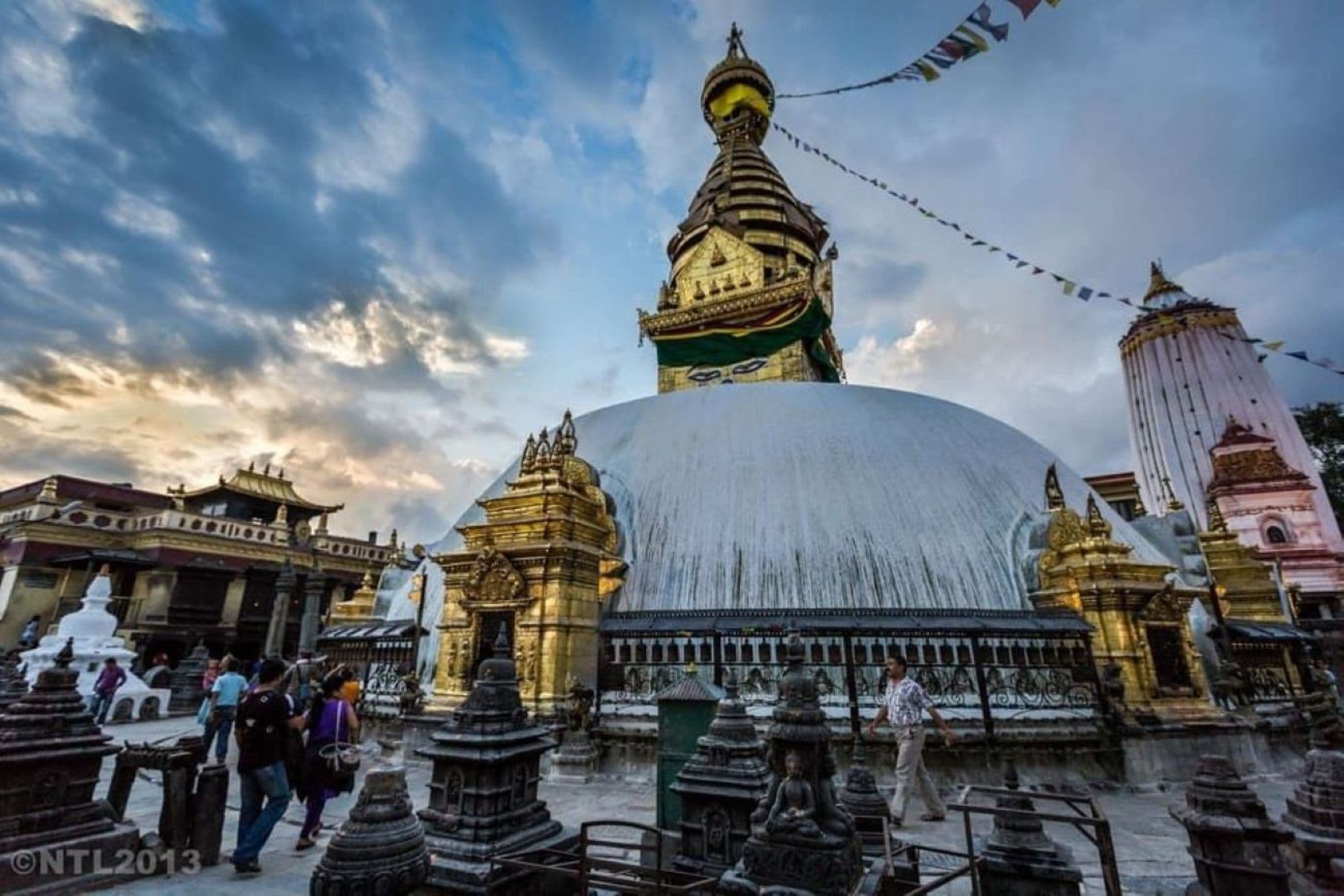
The strikingly beautiful, tall white dome, embellished with a golden spire and adorned with intricate carvings and statues, is the epitome of peace and religious harmony in Nepal. As you are approaching the site on stone steps, the curious monkeys will be keeping a watch over what you have in your bag. Passing by such playful monkeys, the whitewashed dome exhibits its allure as the prayer flags ripple in the breeze. So, are you ready to learn about this beautiful monkey temple and make this place your next destination for a tour in Nepal?
History of Swayambhunath Temple
Now bustling Kathmandu valley was never like this before. In fact, Kathmandu Valley was a vast lake and home to mythical serpents, or Nagas. Even Buddhas, Bodhisattvas, hermits, yogis, gods, and goddesses would come to the lake and purify themselves in its holy waters.
One day Vipassii Buddha visited this lake and planted the seed of a lotus. The lotus became a great flower with a thousand petals, emitting unending light, or Jyotirupa, which, in turn, was reflected in the Five Great Buddhas, Vairocana, Akshobhya, Ratnasambhava, Amitabha, and Amoghasiddhi. This divine light attracted celestial beings such as Shikhi Tathagata, Viswobhu Tathagata, and Buddha Manjushri.
Having received the divine light and looking upon the expanse of the waters of the lake, Manjushri made a decision to open the valley to people. He carved through the surrounding mountains with his indestructible sword, which emptied the lake and created smaller lakes around it, used as homes by the Naga people. The act exposed the valley and enabled people to adore the self-brought light, Swayambhu, which translates to Self-Created.
Other Buddhas, such as Kakusandha, Koanagamana, and Kassapa Buddha also paid reverence to the shining light with time. King Prachandadev of Gaud came to the valley as a result of this deity. He wanted to make a mighty stupa that would guard the light so that the miraculous glow of the lotus would be securely enshrined. Through the teaching of one of the Manjushri devotees, Prachandadev has become a monk and founded the Swayambhunath Stupa, establishing the spiritual center to this day, which makes pilgrims and visitors feel more inspired.
Architecture and Layout of Nepal Swayambhunath Temple
As much as the history of the Swayambhunath temple in Nepal is interesting, the layout and architectural prowess are more captivating and impressive, which make this place a must-visit in a Nepal Holiday Tour. The stupa in itself has three parts: finial, dome, and drum, with the Swayambhunath Stupa height of 40 m. The finial is the top part of the stupa composed of a square cube called Harmica, a pyramid, and finally the pinnacle.
Each face of the Harmica displays the eyes of Buddha above which a 13-layered pyramid stands tall. Likewise, the top section of the stupa is completed with a Gajur and an umbrella. Another important part of the stupa is the dome, which holds the central mast. This semi-hemispherical dome is also called Garbha and is whitewashed on the surface. Beneath the dome, there is the lowest element of the stupa, known as the drum or plinth.
Each structure of the Swayambhunath Stupa was made with great thought and effort. The dome symbolizes the whole world. When an individual wakes up out of the relationships of the world, such an individual attains the enlightenment state. The thirteen steps on the pyramid mean that sentient beings are forced to pass through the thirteen steps of spiritual realizations before attaining enlightenment or Buddhahood.
The eyes, painted on its four sides around the spire of the stupa, symbolize the eyes of the Buddha, and they are facing cardinal directions, which are east, west, north, and south. In between the two pairs of eyes, where the nose would have been, is what appears to be a question mark. This is not just a random question mark symbol, but it is a Nepali character for the number ‘1’. The Nepali number one actually means unity and the one path to achieving enlightenment. On top of this is the third eye, which represents the omniscient wisdom of the Buddha.
Spiritual Significance of Nepal Swayambhunath Temple
Swayambhunath temple in Kathmandu is an important religious site for both Hindu and Buddhist people. While the stupa in itself is the embodiment of Buddha's enlightenment for Buddhist pilgrims, it equally holds the spiritual beliefs for Hindus, too. The temple complex is filled with many small temples and shrines, such as Pratapura, Anantapura, Shantipura, Kindol Bihar, etc.
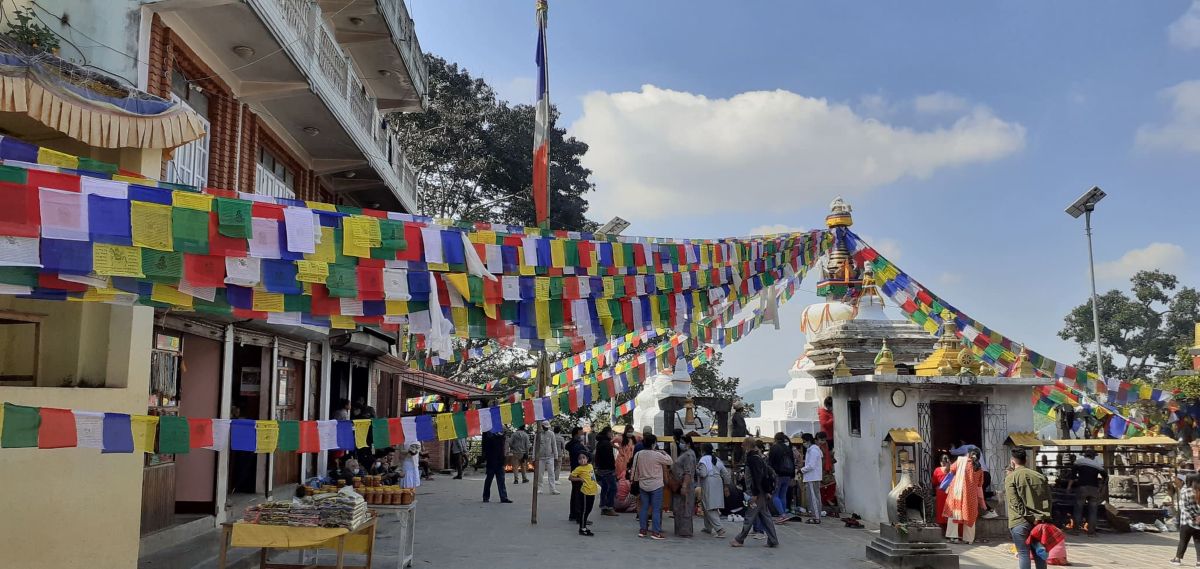
Hence, this iconic landmark not only serves as a spiritual site but also exhibits the religious harmony of the country. Many devotees make a visit to this place to practice prayers and worship. The temple complex is bustling with daily activities such as lighting butter lamps, worshipping, spinning prayer wheels, and many more.
How to Reach Swayambhunath Stupa?
Swayambhunath Stupa lies 3 km west of Kathmandu on the hilltop. The area is easily accessible from many parts of Kathmandu. You can easily hail a taxi or a cab to reach the monkey temple. If you are familiar with the routes, then you can easily use the local bus. Otherwise, apps like Indrive and Pathao can be a more convenient option.
You will have two options to reach the top of the temple. The first step is walking the 365-stone staircase. By doing some cardio and burning calories, you can arrive at the main temple complex. If you don't want to take the stairs, then you can opt for the second option, which is the vehicle road that encircles the hill and takes you to the entrance of the temple on the southwest. No matter which option you opt for, your Kathmandu Valley Tour will definitely be rewarding with a Swayambhnath visit.
Entrance fee for Swayambhunath Temple
If you are a Nepali citizen, then you do not have to pay any fees to enter the temple vicinity. However, if you are a foreign national, then you have to pay about NRS 200 (around USD 2). If you are from an SAARC country, then you have to pay about NRS 50(around 0.4 cents). Children under the age of 10 will get free access to the temple.
Other Major Attractions of Swayambhunath Monkey Temple
1. Expansive City View
The panoramic view of the Kathmandu Valley is one of the most fascinating things about the Swayambhunath Monkey Temple. The stupa, which is situated on a hill, provides a spectacular view where the city expands in all dimensions below. During sunny days, the tourists can observe old neighborhoods, coiled streets, and far hills consolidated on the horizon. The scene is even more enchanted as the sky is painted in warm colours at dawn and at sunset. This serene viewpoint gives the travelers time to relax and enjoy the unity between the urban Kathmandu and the spiritual calmness that is enveloped around the temple during your Kathmandu sightseeing tour.
2. Playful Monkeys
The large number of playful monkeys that move freely around the complex of Swayambhunath has made the complex popularly referred to as the Monkey Temple. These playful animals make the sacred place attractive and animated, and usually amuse the visitors with their curious behavior. The monkeys add a touch of normal life in the spiritual environment through scaling the roof of temples and playfully running after each other. However, they should not be fed, and the visitor is advised to be cautious.
3. Massive brass-plated Vajra
When you are climbing the stone staircase, you will see a huge brass-plated Vahra, also known as Thunderbolt. This lightning bolt is a symbol of achieving enlightenment.
4. The Harati Temple
The Harati Temple is located at the north of the stupa and dedicated to the goddess Hariti or Ajima. Devottee believes that she is the protector of children and the guardian protector of Swayambhunath temple. This two-storey temple is a great example of architecture with its stone inscriptions, wooden and metal works.
5. Pratapura and Anantapura
Both of these temples are the shikara-style temples located within the stupa complex. The Pratpura temple was built by King Pratap Malla in 1654 A.D. and dedicated to the god Mahasambhar. Likewise, Anantapura is dedicated to the goddess Nil Saraswati and Ugratara and was built by one of the queens of Pratap Malla in 1654 A.D.
Swayambhunath is a timeless gem where spirituality, history, and stunning city views come together. Its serene stupa, playful monkeys, and panoramic vistas make every visit unforgettable. You can experience these rewarding moments with Mountain Adventure Trekking Pvt Ltd and step into the heart of Kathmandu’s charm and culture. Contact us today.