5 Most Difficult Treks in Nepal: The Ultimate Guide to the Toughest Routes
The most difficult treks in Nepal are not harder versions of the Everest Base Camp hike. They are fundamentally different types of expeditions. The Dhaulagiri Circuit, the Kanchenjunga North-to-South Traverse, and the Great Himalaya Trail require glacier travel, multi-week self-sufficiency, and a genuine acceptance that rescue may not be possible if something goes wrong.
If you are reading this because you crushed the Annapurna Circuit and want something tougher, understand that the jump from a teahouse trek to an expedition-grade route is not incremental. It is a complete category shift. The trails disappear. The teahouses don't exist. And the margin between a hard day and a life-threatening situation shrinks to almost nothing.
Here are the 5 hardest treks in the country, ranked by the combination of technical skill, physical endurance, and logistical complexity required to finish them.
1. The Dhaulagiri Circuit (18–22 Days)
The One That Breaks Experienced Trekkers
Dhaulagiri is the seventh-highest mountain on earth at 8,167 meters. The circuit around its base is widely considered the single hardest commercial trek available in Nepal.
The route starts innocently enough. You walk up the Myagdi Khola river valley through green forests and small villages. But after the settlement of Muri, the trail tilts violently upward into the uninhabited glacial zone, and it stays there for days.
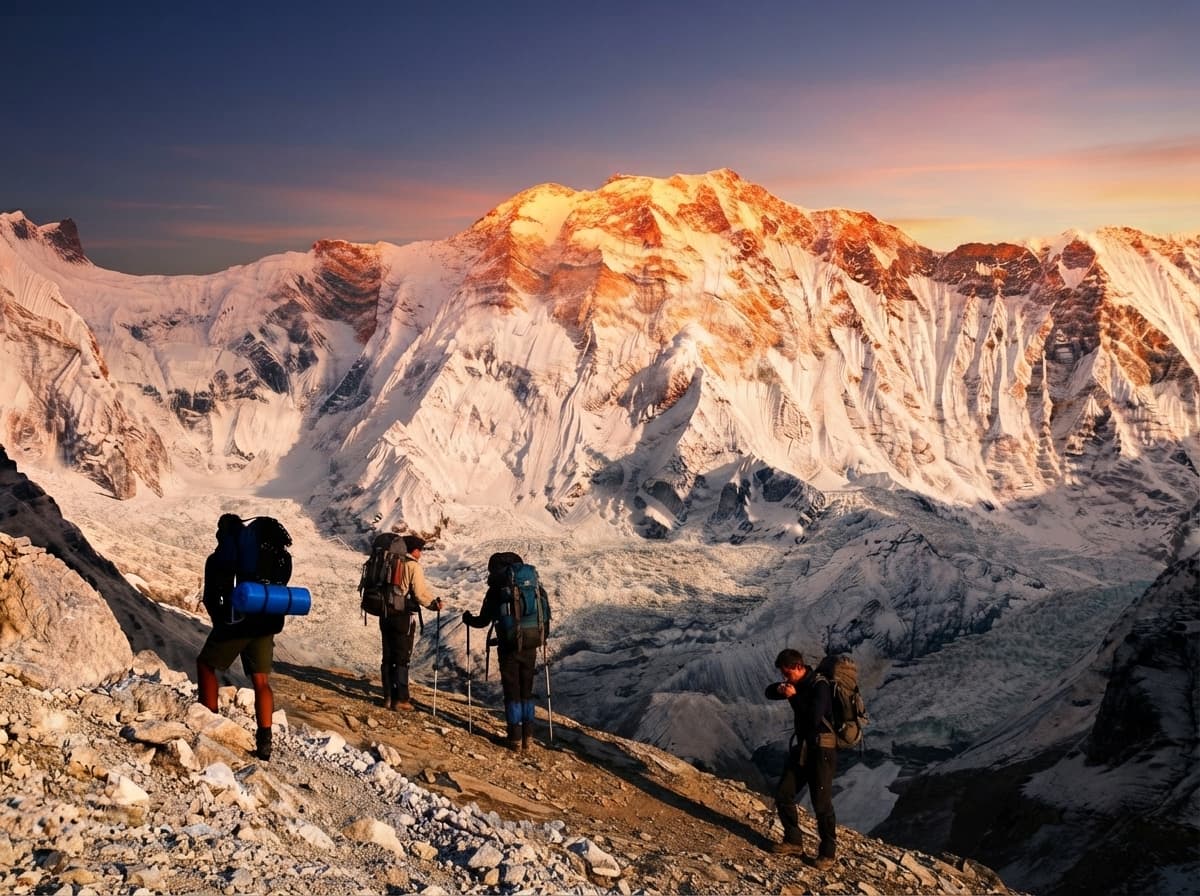
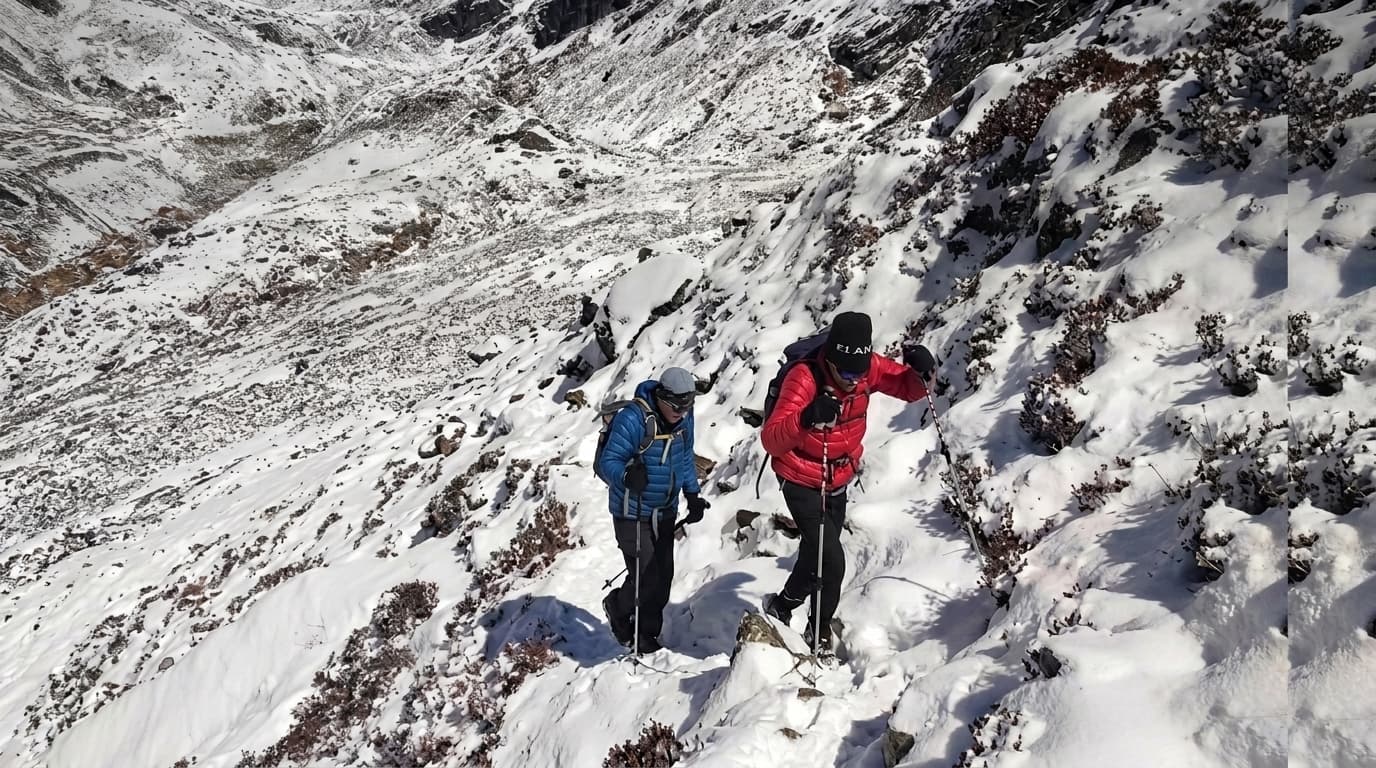
The crux of the entire trek is the approach to French Pass (5,360m) and Dhampus Pass (5,258m). You are not walking on a dirt path here. You are navigating active glacial terrain — loose moraine, crevassed ice fields, and steep snowfields that require crampons and an ice axe.
If you don't know how to self-arrest on a 40-degree ice slope, you have no business being here.
Camp conditions above 4,800 meters are brutal. Temperatures drop to minus 20°C at night. The wind on the exposed glacier is relentless. You are carrying everything — food, fuel, shelter — because there is nothing and no one up there to help you.
Why it's #1: It combines extreme altitude, genuine technical glacier travel, and total isolation in a way that no other trek in Nepal does. Even strong Annapurna Circuit veterans get turned around on French Pass.
2. The Kanchenjunga North-to-South Traverse (25–30 Days)
A Month of Walking to the Third-Highest Mountain
Kanchenjunga sits in the extreme far east of Nepal, pressed against the borders of India and Tibet. Just getting to the trailhead requires a domestic flight to Bhadrapur or Suketar, followed by days of jeep travel on terrible roads.
The full traverse hits both the North Base Camp (Pangpema, 5,143m) and the South Base Camp (Oktang, 4,500m). The route between them crosses the Mirgin La pass and traverses terrain that sees fewer than 200 trekkers per year. Below Ghunsa, you pass through dense subtropical jungle alive with leeches. Above Ghunsa, you enter a high-altitude wasteland where the teahouses are unreliable at best and completely closed at worst.
The sheer duration is what makes this trek so punishing. Walking for 25 to 30 consecutive days destroys your body in ways that a two-week trek simply doesn't. By week three, your joints are swollen, your appetite is gone, and your mental discipline is the only thing keeping you moving forward.
Why it's #2: The combination of extreme remoteness, high passes, monsoon-season leech forests, and a month-long timeline makes this a genuine test of endurance and mental toughness.
3. The Makalu Base Camp to Everest Traverse via Sherpani Col (22–28 Days)
The Most Technically Demanding Route in Nepal
This is not a trek in the traditional sense. It is a high-altitude mountaineering traverse that happens to not summit a peak.
The route starts with the already-difficult Makalu Base Camp trail through the Barun Valley. But instead of turning around at Makalu's base, you continue west, crossing three high passes — the Sherpani Col (6,146m), the West Col (6,190m), and the Amphu Lapcha (5,845m) — before descending into the Khumbu valley near Chhukung.
Every single one of those passes involves technical rope work. You will be ascending and descending near-vertical ice walls using fixed ropes, jumars, and rappel devices. You will cross crevassed glaciers roped to your team. If you don't have prior mountaineering training, this route will either kill you or your guide will refuse to take you past the first col.
Why it's #3: The technical difficulty of the three high passes exceeds anything else on this list. You need actual climbing skills, not just fitness and determination.
The Difficulty Comparison
| Trek | Days | Max Altitude | Technical Skills Needed | Teahouse Available? |
| Dhaulagiri Circuit | 18–22 | 5,360m | Crampons, ice axe, glacier navigation | No. Full camping. |
| Kanchenjunga Traverse | 25–30 | 5,143m | Basic high-altitude trekking | Partial. Unreliable above Ghunsa. |
| Makalu–Sherpani Col | 22–28 | 6,190m | Rope work, jumaring, rappelling, glacier travel | No. Full expedition camping. |
| Upper Dolpo Circuit | 25–30 | 5,190m | High-altitude trekking, river crossings | No. Full camping. |
| Great Himalaya Trail | 150+ | 6,146m | Everything. All of the above. | Mixed. Varies by section. |
4. The Upper Dolpo Circuit (25–30 Days)
Weeks of Walking Through Almost Nothing
Upper Dolpo is not technically demanding in the way that the Dhaulagiri Circuit or the Sherpani Col traverse are. You don't need ropes or ice axes. What makes Dolpo one of the hardest treks in Nepal is the sheer, grinding logistical weight of being completely self-sufficient for weeks in a landscape that offers almost no resupply.
The route crosses multiple passes above 5,000 meters. The trails are frequently unmarked or buried under rockfall. Between the tiny settlements of Saldang, Shimen, and Dho Tarap, you can walk for five to eight days without encountering another human being. You carry every meal, every liter of fuel, and every piece of shelter on the backs of your porters or pack animals. If a porter gets injured, your expedition is in serious trouble because there is no one to replace them.
The restricted-area permit for Dolpo is one of the most expensive in Nepal, running $500 per person for the first 10 days and $50 per day after that. This alone filters out casual trekkers and keeps the route almost empty.
Why it's #4: Dolpo tests your ability to manage a complex, multi-week expedition in total isolation. The difficulty is logistical and psychological, not technical.
5. The Great Himalaya Trail — Full Traverse (150+ Days)
The Entire Country, On Foot
This is the final boss. The Great Himalaya Trail runs the entire length of Nepal, east to west (or west to east), covering roughly 1,700 kilometers. The high route passes through every single major mountain region — Kanchenjunga, Makalu, Everest, Rolwaling, Langtang, Manaslu, Annapurna, Dhaulagiri, Dolpo, and Humla.
Walking the full GHT means crossing every difficult pass on this list. It means spending five months continuously in the mountains. It means dealing with the full seasonal cycle — starting in post-monsoon warmth and finishing in deep winter cold (or vice versa). It means resupplying in remote villages where the only available food is rice and dried potatoes.
Fewer than 200 people in recorded history have completed the full high route. It is not a trek you "decide to do" on a whim. It requires months of advance logistics, a support team, a massive budget, and the kind of physical and mental conditioning that borders on professional athleticism.
Why it's #5 (but actually #1 in scale): It is the hardest thing you can walk in Nepal. It encompasses every type of difficulty — technical, logistical, physical, and psychological — stretched over half a year.
What You Actually Need to Prepare
If you are seriously considering any of these five routes, your preparation needs to go far beyond "I'll hit the gym for a month."
Physical Conditioning (Start 6 Months Out) You need to train specifically for sustained multi-week effort. Running a marathon is great, but it is a single-day event. These treks demand that you wake up on day 18 with blistered feet and swollen knees and still put in a 7-hour day with a heavy pack. Train with back-to-back long hiking days, every weekend, for months. Load your pack with 15 to 20 kilograms and walk up the steepest terrain you can find.
Technical Skills (Non-Negotiable for #1 and #3) If your route involves glacier travel, you must take a basic mountaineering course before you leave home. You need to know how to walk in crampons, use an ice axe for self-arrest, clip into a fixed rope with a jumar, and rappel. Showing up at French Pass without these skills is not brave — it is reckless.
Gear That Actually Matters Forget the ultralight philosophy you read about on Reddit. On an expedition-grade trek in Nepal, you need bombproof, four-season gear.
- A minus 20°C rated sleeping bag. Not a "comfort-rated" bag — a survival-rated bag.
- Double-wall mountaineering tent rated for high winds.
- A satellite communicator. Not your phone. Your phone is dead weight above 4,000 meters with no cell towers.
- Crampons, ice axe, harness, and a helmet if the route crosses glacial terrain.
Frequently Asked Questions
Can a strong beginner do any of these treks?
No. Every route on this list assumes you have already completed at least one or two standard high-altitude treks in Nepal (EBC, Annapurna Circuit, Manaslu) and are comfortable with multi-day walking above 4,000 meters. If you haven't done that yet, you are not ready for these.
How much do the hardest treks cost?
Because these routes require full camping logistics, porters, cooks, and restricted-area permits, they are significantly more expensive than teahouse treks. Budget $4,000 to $8,000 USD per person for a fully supported Dhaulagiri Circuit or Kanchenjunga Traverse. The Makalu–Sherpani Col route can exceed $10,000 due to the technical guiding requirements.
What is the best season for extreme treks?
The autumn window — late September through November — is the standard. Skies are clear after the monsoon, temperatures are manageable, and the passes are typically free of heavy snow. Spring (March to May) works for lower routes but carries avalanche risk on the higher glacier passes.
Do I need a guide for these treks?
It is legally mandatory, and on these routes, it is the difference between survival and catastrophe. You need a licensed, experienced high-altitude guide who has walked the specific route before. Do not cut corners on this.
The Bottom Line
The most difficult treks in Nepal are not Instagram adventures. They are serious, multi-week expeditions into some of the most hostile terrain on the planet. The views are unmatched. The sense of achievement is life-altering. But the price of entry is months of physical preparation, thousands of dollars in logistics, and the humility to turn around if conditions or your body tell you to stop.
If you have the experience and the drive to attempt one of these routes, start by getting matched with a guide team that has actually completed it before. Check our [Expedition-Grade Nepal Trekking Packages] to connect with vetted local operators who specialize in these extreme routes.