Annapurna Base Camp vs Annapurna Circuit: Which Trek Is Best?
The Annapurna Base Camp trek and the Annapurna Circuit are both world-class routes in the same mountain range, but they deliver fundamentally different experiences. ABC is a 7-to-11-day in-and-out walk into a glacial amphitheater at 4,130 meters — intense, vertical, and affordable. The Annapurna Circuit is a 12-to-18-day loop around the entire Annapurna massif, crossing five climate zones and a 5,416-meter pass — epic in scope but partly impacted by road construction on the lower sections. Choosing between them comes down to how much time you have, how high you want to go, and whether you want one knockout panorama or three weeks of changing landscapes.
Annapurna Base Camp vs Annapurna Circuit — At a Glance
Before the detail, here is the direct comparison in one table. This is what most trekkers are actually looking for when they search "Annapurna Base Camp vs Annapurna Circuit," so let's start there.
Factor | Annapurna Base Camp (ABC) | Annapurna Circuit |
| Duration | 7–11 days (most do 9–10) | 12–18 days (most do 14–16) |
| Maximum Altitude | 4,130m / 13,550 ft | 5,416m / 17,769 ft (Thorong La Pass) |
| Total Distance | ~70–100 km | ~160–230 km |
| Route Type | Out-and-back (same trail in and out) | Full loop around the massif |
| Difficulty | Moderate | Strenuous |
| Cost (Local Operator, 2027) | $800 – $1,150 per person | $1,000 – $1,800 per person |
| Permits Required | ACAP + TIMS (~$42) | ACAP + TIMS (~$42) |
| Best Months | Oct–Nov, Mar–May | Oct–Nov, Mar–Apr |
| Road Impact | Minimal — jeep track to trailhead only | Significant on lower sections (both valleys) |
| Highest Cultural Diversity | Gurung and Magar villages | Gurung → Manangba → Tibetan-Buddhist → Thakali |
| Technical Skills Needed | None | None, but high-pass fitness and altitude experience strongly recommended |
| Starting City | Pokhara | Pokhara (via Besisahar or Chame) |
That table gives you the skeleton. But the table doesn't tell you what it actually feels like to walk each route, or how road construction has changed the equation over the last few years. That's what matters.
What Does Each Trek Actually Look Like?
Annapurna Base Camp: The Amphitheater Walk
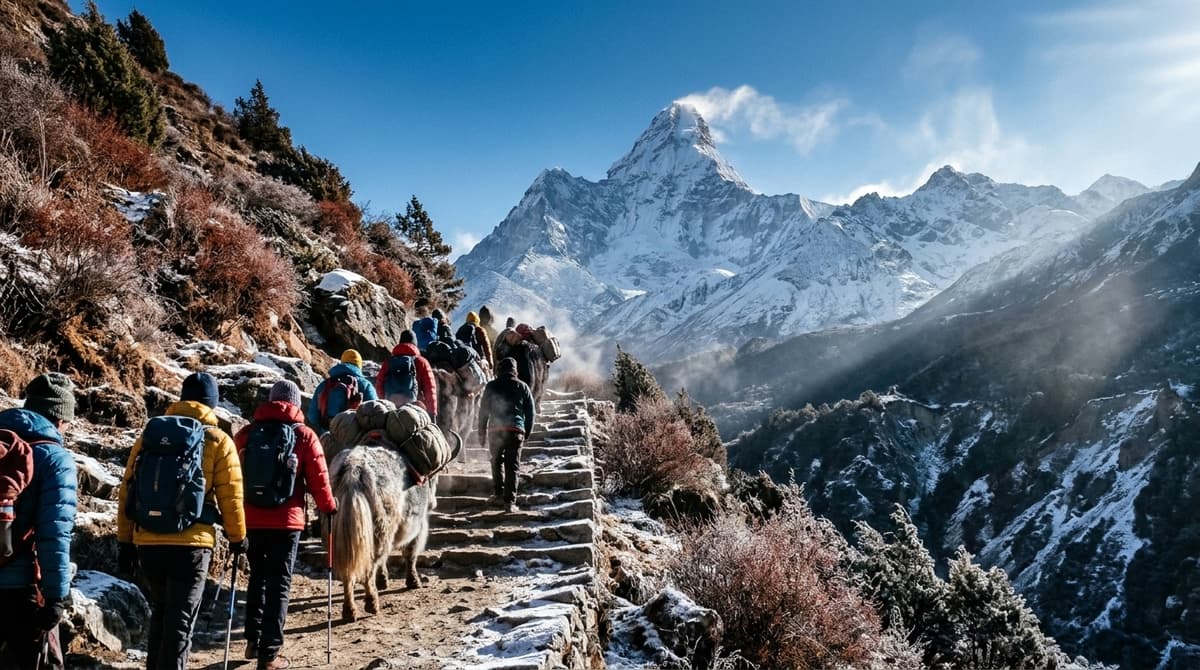
The Annapurna Base Camp trek is a vertical corridor. You start in the subtropical foothills near Pokhara — rice terraces, banana trees, warm air — and walk north into a progressively narrower canyon along the Modi Khola river until you emerge into one of the most dramatic mountain amphitheaters on earth.
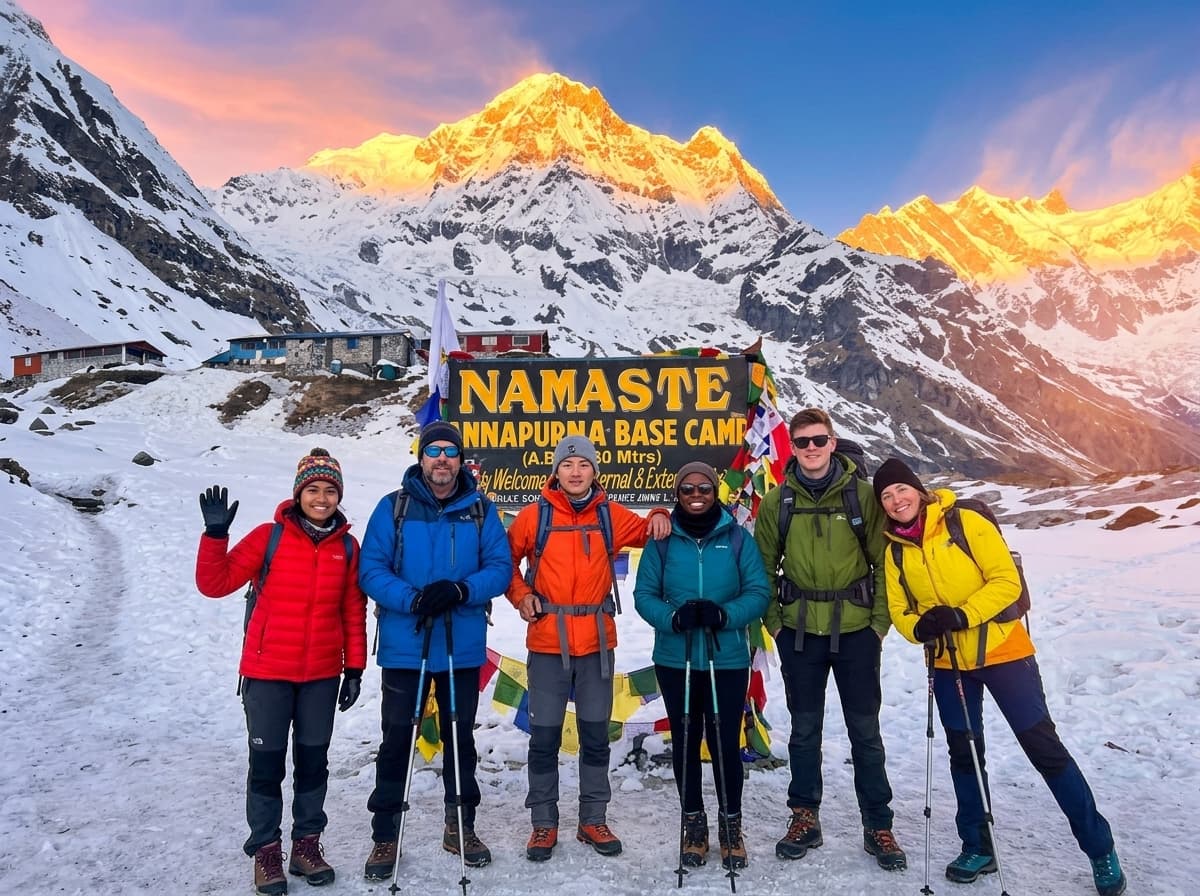
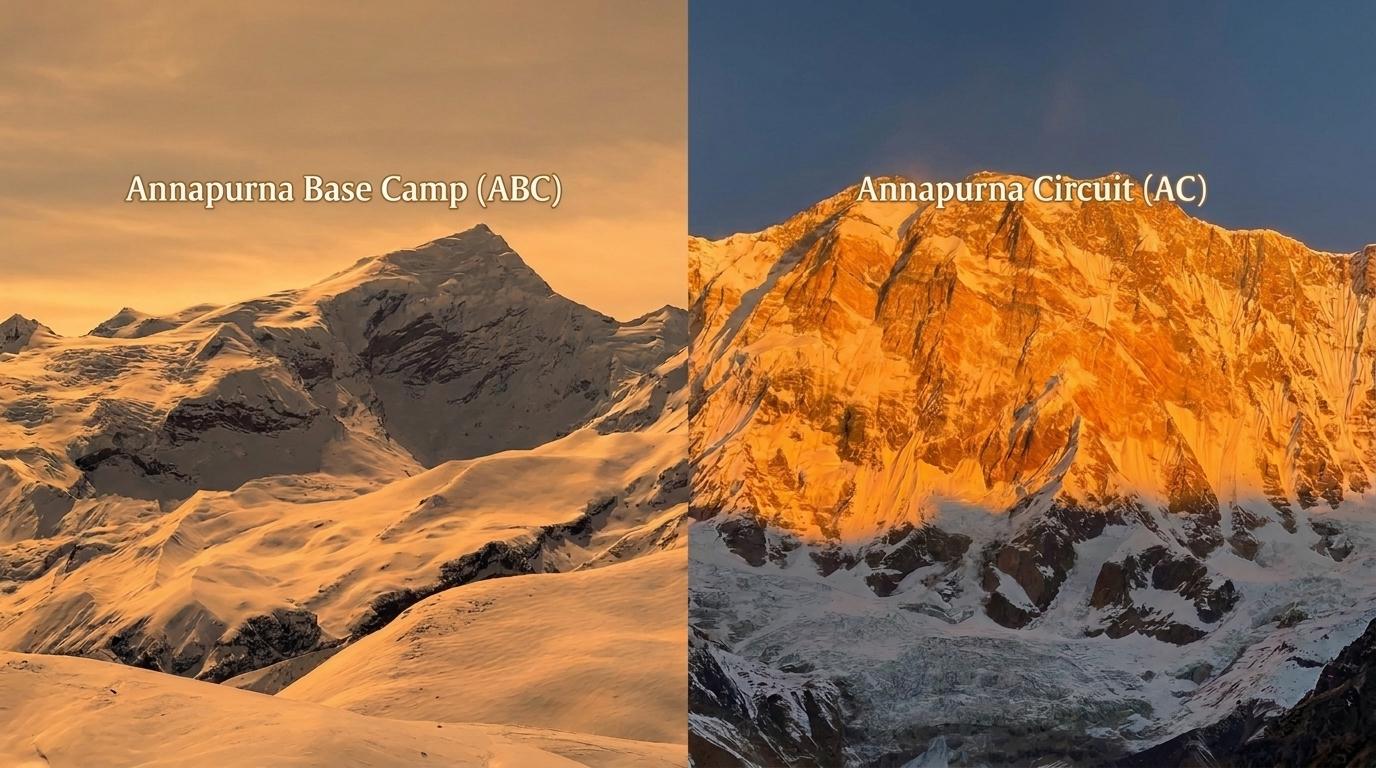
At 4,130 meters, Annapurna Base Camp sits inside a natural ring of peaks: Annapurna I (8,091m), Annapurna South (7,219m), Hiunchuli (6,441m), Gangapurna (7,455m), and the unmistakable fishtail summit of Machhapuchhre (6,993m). The scale of the place doesn't make sense until you stand in it. Your brain needs a few seconds to process how large the walls around you actually are.
The route follows stone staircases — thousands of them — through Gurung villages like Ghandruk and Chhomrong, dense rhododendron forest, bamboo groves, and finally a barren glacial landscape above Deurali. It's an in-and-out trek, meaning you walk the same path up and down, though many groups take the [Ghorepani Poon Hill side route] on the return for variety.
There's a spot about forty minutes above Deurali where the trail turns a blind corner and Annapurna South's entire face fills your field of vision without warning. I've watched hundreds of trekkers hit that corner. Nobody talks for a minute after.
Annapurna Circuit: The Full Loop
The Annapurna Circuit is not a walk toward one destination. It's a walk around an entire mountain range. Over two to three weeks, you cross five climate zones — subtropical river valley, temperate forest, high-altitude arid steppe, alpine pass, and the deepest river gorge on the planet.
The trek traditionally starts in Besisahar in the Marsyangdi valley, climbs gradually through Hindu farming villages into the Tibetan-Buddhist settlement of Manang (3,540m), crosses the 5,416-meter Thorong La Pass — the highest point most non-mountaineers will ever stand — and descends through Muktinath and the Kali Gandaki gorge toward Jomsom and eventually back to Pokhara.
The cultural shift is what makes the Circuit genuinely unusual. You begin in green valleys where Hindu temples sit beside rice paddies and Bollywood songs play from teahouse radios. By the time you reach Manang, you're in a Tibetan landscape — prayer flags, mani walls, yak pastures, and monasteries carved into cliffs. The transition happens gradually over days, and then one morning you wake up and realize the world has completely changed. That shift, more than the pass itself, is what people remember about the Circuit.
But here's the complication.
How Has Road Construction Changed the Annapurna Circuit?
This is the single most important question for anyone considering the Circuit in 2027, and most comparison articles online skim over it or pretend it isn't a factor. So let's be direct.
Road construction has altered approximately 40% to 50% of the traditional Annapurna Circuit trail. Motorable jeep tracks now extend deep into the Marsyangdi valley on the eastern approach — from Besisahar all the way up through Dharapani, Chame, and into the outskirts of Manang village. On the western descent, a continuous road connects Muktinath down through Jomsom, Marpha, Ghasa, and onward to Beni and Pokhara.
What this means practically:
- On dusty-road sections, trekkers share the trail with jeeps, motorbikes, and local buses. It's not constant traffic, but it's enough to break the wilderness feeling.
- The classic 21-day walk from Besisahar to Pokhara is rarely done entirely on foot anymore. Most trekkers now start their walk at Chame or Dharapani (skipping the dustiest lower stretches by jeep) and end at Muktinath or Jomsom (catching a jeep or flight down instead of walking the Kali Gandaki road).
- The high core — Manang to Thorong La Pass to Muktinath — has zero roads and zero vehicle traffic. No engine has crossed Thorong La and none will. That section remains pure trail.
The good news is the NATT (New Annapurna Trekking Trails) project has created dedicated footpaths that divert walkers away from the jeep tracks on lower sections. The upper route from Pisang through Ghyaru and Ngawal to Manang, for example, is a high ridgeline trail with extraordinary views that avoids the valley road entirely. A guide who knows the NATT network can route you around most of the motorable sections.
But I should be honest: if your image of the Annapurna Circuit is an unbroken three-week wilderness walk with zero motorized traffic, that image belongs to about 2010. The trek is far from ruined — the high sections are as extraordinary as they ever were — but the lower valleys have changed, and pretending otherwise would be dishonest.
The Annapurna Base Camp trek has minimal road impact by comparison. A jeep track reaches the trailhead at Siwai or Nayapul, and that's where the road stops. The entire trail from the first stone step to Base Camp is foot traffic only.
Which Trek Is Harder?
The Annapurna Circuit is harder. But the Annapurna Base Camp trek is harder than most people expect.
ABC Difficulty: Moderate (With a Sting)
Annapurna Base Camp tops out at 4,130 meters — well below the threshold where severe altitude sickness typically strikes. The challenge is not altitude. The challenge is stairs.
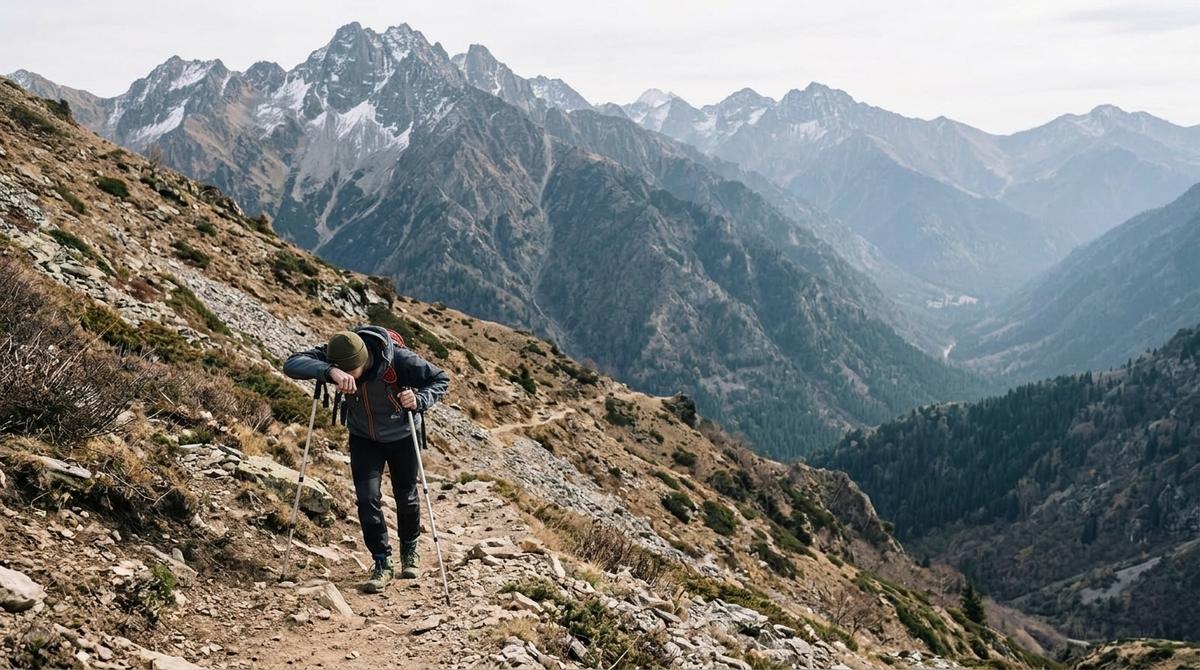
The ABC trail is essentially a giant stone staircase carved into the side of the Modi Khola valley. Between Tikhedhunga and Ghorepani, you'll climb roughly 3,300 stone steps in a single morning. Between Chhomrong and Sinuwa, another 2,500 steps down, then back up. Your quads and knees will remember this trek long after you've forgotten the view. (Well, you won't forget the view. But your knees will be louder about it.)
If you're a regular gym-goer who has never done a multi-day mountain trek, ABC will challenge you physically but it won't overwhelm you — provided you've done the stair conditioning work beforehand. Our Annapurna Base Camp trek preparation guide covers the specific eccentric quad training that makes the difference between sore knees and damaged knees.
Circuit Difficulty: Strenuous (Altitude + Duration)
The Annapurna Circuit tops out at 5,416 meters — Thorong La Pass. That altitude is a completely different game. Above 5,000 meters, your blood oxygen saturation drops significantly, every step requires noticeably more effort, and acute mountain sickness becomes a real and present risk rather than a theoretical concern.
The pass day itself is the crux: most groups leave Thorong Phedi or High Camp at 3 or 4 in the morning, climb roughly 1,000 vertical meters in freezing darkness, cross the pass in wind and potentially snow, and descend 1,600 meters to Muktinath — all in a single day. That's a 10-to-14-hour day at extreme altitude. It is genuinely hard, and trekkers who have only walked below 4,000 meters before are sometimes shocked by how different 5,400 meters feels.
But the Circuit also demands endurance over duration. Walking six to eight hours a day for 14 to 18 consecutive days is a different kind of fatigue than a 10-day trek. By day twelve your body works fine but your motivation can wobble. The mental grind is real.
Difficulty Factor | Annapurna Base Camp | Annapurna Circuit |
| Maximum altitude | 4,130m — moderate risk | 5,416m — significant altitude risk |
| Altitude sickness risk | Low to moderate | Moderate to high (especially pass day) |
| Daily walking hours | 5–7 hours | 5–8 hours |
| Total consecutive days | 7–11 days | 12–18 days |
| Steepest physical challenge | Stone staircases (3,000+ steps/day) | Thorong La crossing (1,000m ascent at 5,000m+) |
| Technical climbing needed | None | None, but crampons occasionally useful on icy pass |
| Prior trekking experience needed | Not required, but helpful | Strongly recommended (any trek above 4,000m) |
How Much Does Each Trek Cost in 2027?
Both treks share the same ACAP permit (NPR 3,000, roughly 23–25) and TIMS card (NPR 2,000, roughly $15), so permit costs are identical. The price difference comes from duration, transport logistics, and food costs at altitude.
For a detailed line-by-line breakdown of the ABC trek budget, see our complete Annapurna Base Camp trek cost guide for 2027.
Cost Category | ABC (10 Days) | Circuit (15 Days) |
| Permits (ACAP + TIMS) | ~$42 | ~$42 |
| Transport (from Pokhara) | 30–50 (jeep to Siwai) | 50–100 (bus/jeep to Besisahar or Chame) |
| Licensed Guide | 300–350 (10 days × 30–35/day) | 420–525 (14–15 days × 30–35/day) |
| Porter | 200–250 (10 days × 20–25/day) | 280–375 (14–15 days × 20–25/day) |
| Teahouse Rooms | 60–90 | 85–140 |
| Food & Hot Drinks | 250–350 | 370–520 |
| Incidentals (showers, charging, Wi-Fi) | 60–95 | 90–140 |
| Total (Standard Local Operator) | $800 – $1,150 | $1,000 – $1,800 |
The Circuit costs more because you're on the trail for roughly 50% longer. More days means more guide wages, more porter wages, more food, more teahouse nights. The food at altitude on the Circuit — particularly between Thorong Phedi and Muktinath — is also slightly more expensive than on ABC because supply lines into the Manang valley are longer.
One cost trap on the Circuit that nobody mentions online: if weather grounds you at Thorong Phedi or High Camp for an extra day (which happens regularly in late October and November), you burn through roughly $80 to $120 per day in accommodation, food, and crew wages while waiting. Budget at least two contingency days into your Circuit plan.
Which Trek Has Better Scenery?
This is the question I get asked most, and it's the wrong question. They have different scenery — not better or worse scenery.
ABC gives you intensity. The payoff moment is singular and overwhelming: standing inside a 360-degree ring of 7,000-meter and 8,000-meter peaks. The amphitheater at Base Camp, especially at sunrise when the light hits Annapurna South's ice wall, is one of the most concentrated mountain views in Nepal. The journey to get there — rhododendron forests, bamboo groves, waterfalls, Gurung villages with slate roofs — is beautiful, but it's supporting act for the main stage.
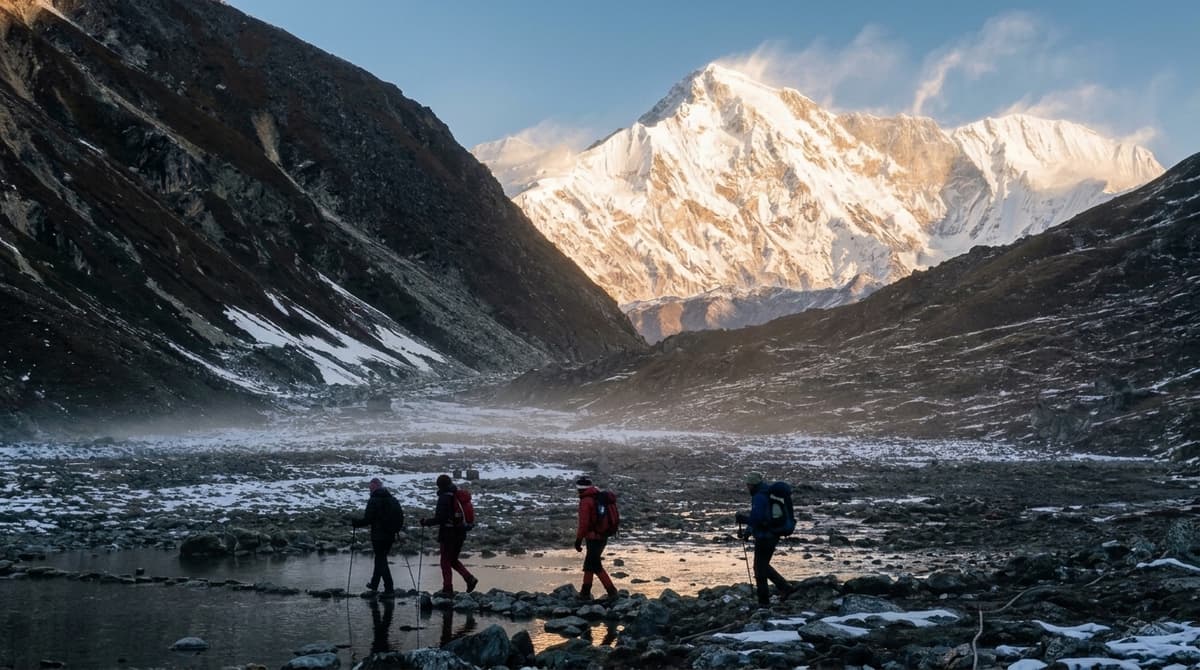
The Circuit gives you range. The scenery changes every two or three days in ways that feel like you've crossed into a different country. Lush green rice paddies near Besisahar. Pine forests around Chame. The arid, almost Martian landscape of the Manang valley. The frozen moonscape above Thorong Phedi. The medieval trading town of Marpha with its white stone walls and apple orchards. The impossibly deep Kali Gandaki gorge where you walk between two 8,000-meter peaks (Dhaulagiri and Annapurna) separated by only 35 kilometers.
If you want one transcendent mountain moment, do ABC. If you want a journey that changes shape every morning, do the Circuit.
I just told you the Circuit has more scenic variety, and that's true. But I should also say that some of the Circuit's lower sections — the stretches where you're walking alongside a jeep road — are not particularly scenic anymore. Dust, road cuts, and the occasional horn blast from a passing truck don't help the mood. The upper sections are still magical. But you earn them.
Which Trek Is Better for Beginners?
Annapurna Base Camp is the better first trek in Nepal.
The altitude is manageable at 4,130 meters. The daily walking hours are reasonable at five to seven hours. The teahouses are well-spaced, meaning you're never more than two or three hours from a warm lodge. And the route starts and ends near Pokhara, which is one of the most comfortable cities in Nepal for decompressing after a trek.
The Annapurna Circuit is not a beginner's route — not because it requires technical skills (it doesn't), but because Thorong La Pass at 5,416 meters demands experience managing your body at altitude. Knowing when to push, when to stop, and when to turn around is something you develop over multiple high-altitude treks. First-timers can absolutely complete the Circuit, and many do, but the margin for error is smaller and the consequences of poor acclimatization are more serious.
Beginner Suitability | ABC | Circuit |
| First multi-day trek ever? | Yes — well suited | Possible but not ideal |
| No altitude experience? | Yes — 4,130m is manageable | Risky — 5,416m requires acclimatization knowledge |
| Limited vacation time (10 days)? | Yes — fits perfectly | No — need minimum 14+ days |
| Fitness level: moderate (regular walking/gym) | Sufficient | Recommended to also train with loaded pack and altitude simulation |
A practical shortcut for deciding: if you have done a multi-day trek above 4,000 meters before — anywhere in the world — the Circuit is within your reach. If ABC or a similar moderate trek would be your first, start there and do the Circuit next year.
When Is the Best Season for Each Trek?
Both treks share the same peak seasons — October and November for autumn, March through May for spring — but they respond to weather differently because of their altitude profiles.
Season | ABC | Circuit | Notes |
| October | Excellent (clear, stable, 10–15°C days) | Excellent but crowded | Peak season for both. Book teahouses 2+ weeks ahead on Circuit. |
| November | Excellent (colder nights, fewer crowds) | Good, but Thorong La may see early snow | Late November carries slight pass-closure risk. |
| December–February | Possible below Deurali (~3,200m), risky above | Thorong La frequently closed | ABC works as a winter trek to MBC (3,700m). Circuit is off-limits for most trekkers in winter. |
| March–April | Excellent (rhododendrons bloom below 3,000m) | Excellent — pass is open, spring wildflowers | Best spring window for both routes. |
| May | Good but hot at lower altitudes | Warm, hazy, pre-monsoon storms | Trail gets sticky and leeches appear below 2,500m. |
| June–September | Not recommended (monsoon, leeches, landslides) | Not recommended | Both routes are heavily affected by monsoon rain. |
One seasonal difference worth noting: the Circuit has a narrower optimal window than ABC. Because Thorong La Pass sits at 5,416 meters, it can close with heavy snowfall anytime between late November and mid-March. ABC's maximum altitude is almost 1,300 meters lower, which keeps it accessible longer into winter and earlier in spring.
Which Trek Is More Crowded?
The Annapurna Base Camp trek draws larger crowds in a more concentrated space. The trail is a single corridor — there's one way in and one way out — and during peak October weeks, the narrow canyon between Deurali and Base Camp can feel like a queue. Teahouses at ABC itself only have roughly 60 to 80 beds, and in late October they're fully booked every night.
The Annapurna Circuit spreads its trekkers across a 200-kilometer loop. Even during peak season, you rarely feel crowded between Manang and the pass because the trail stretches across such a long distance. The exception is Thorong Phedi and High Camp on the night before the pass crossing — those lodges get packed, and if you don't have a reservation, you may end up sleeping in a dining hall.
If crowd avoidance is a high priority for you, the Circuit has the advantage — especially if you hike the upper NATT trails from Pisang to Ngawal, where you might not see another trekker for hours.
The Decision Framework: ABC or Circuit?
After twelve years of sending groups on both routes, here is the simplest way I know to frame the decision:
Choose ABC If... | Choose the Circuit If... |
| You have 10 days or fewer for the trek | You have 14+ days and prefer an extended journey |
| This is your first multi-day mountain trek | You have previous trekking experience above 4,000m |
| You want one extraordinary mountain panorama | You want landscape diversity across five climate zones |
| You prefer a more affordable trek (800–1,150) | You're comfortable spending 1,000–1,800 |
| Road construction matters to you (ABC has minimal road impact) | You don't mind some road walking or can use NATT alternate trails |
| You value a post-trek soak in [Jhinu Danda hot springs] | You want the achievement of crossing a 5,416m pass |
| You're traveling in December or January | You're traveling October–November or March–April only |
Neither route is objectively better. They solve different problems. ABC is the concentrated masterpiece — fewer days, less money, lower altitude, one devastating panorama. The Circuit is the grand epic — more time, more cost, higher altitude, and a journey that changes character every morning for two weeks.
And honestly? Most trekkers who do one come back within two years to do the other. That's how it usually goes.
Frequently Asked Questions
Is the Annapurna Circuit still worth doing with all the road construction?
Yes, the Annapurna Circuit is still worth doing in 2027. Road construction affects roughly 40% to 50% of the lower-valley sections on both the Marsyangdi and Kali Gandaki sides, but the high core from Manang to Thorong La Pass to Muktinath remains road-free. Most trekkers now skip the dustiest lower stretches by starting at Chame or Dharapani and use the NATT alternate footpaths to avoid jeep tracks where possible.
Which trek is better for a complete beginner — ABC or the Circuit?
The Annapurna Base Camp trek is better suited for first-time trekkers. ABC tops out at 4,130 meters, requires no technical skills, and takes 7 to 11 days. The Annapurna Circuit reaches 5,416 meters at Thorong La Pass and demands two to three weeks, making it better suited for trekkers who have completed at least one multi-day trek above 4,000 meters.
Can I do both Annapurna Base Camp and the Annapurna Circuit on the same trip?
Technically yes, but very few trekkers do. A combined itinerary would require roughly 25 to 30 days of continuous trekking, which is physically demanding and logistically complex. If you have a full month in Nepal and excellent fitness, you could do ABC first (10 days), rest for 2 to 3 days in Pokhara, and then start the Circuit (15 days). Most trekkers prefer doing them on separate trips.
Do I need a guide for both treks?
Since 2023, Nepal's tourism regulations require a licensed trekking guide for the Annapurna Conservation Area, which covers both the ABC route and the full Annapurna Circuit. Independent solo trekking without a registered guide is no longer legally permitted on either route. A licensed guide costs approximately $30 to $35 per day and handles lodge reservations, checkpoint permits, and emergency coordination.
How much more expensive is the Annapurna Circuit than ABC?
The Annapurna Circuit costs roughly 30% to 50% more than the Annapurna Base Camp trek. A standard ABC trek with a local operator runs $800 to $1,150 per person for 10 days. A standard Circuit trek runs $1,000 to $1,800 per person for 14 to 16 days. The difference comes primarily from additional days of guide wages, porter wages, food, and teahouse accommodation.
What happens if Thorong La Pass is closed due to snow?
If heavy snowfall closes Thorong La Pass, Circuit trekkers typically wait one to two days at Thorong Phedi or High Camp for conditions to improve. If the pass remains impassable, you may need to retrace your route back through Manang and exit via the Marsyangdi valley — effectively completing half the circuit. This is most common in late November through March. Travel insurance that covers trip alteration is strongly recommended for Circuit treks.
Is the Annapurna Base Camp trek easier than Everest Base Camp?
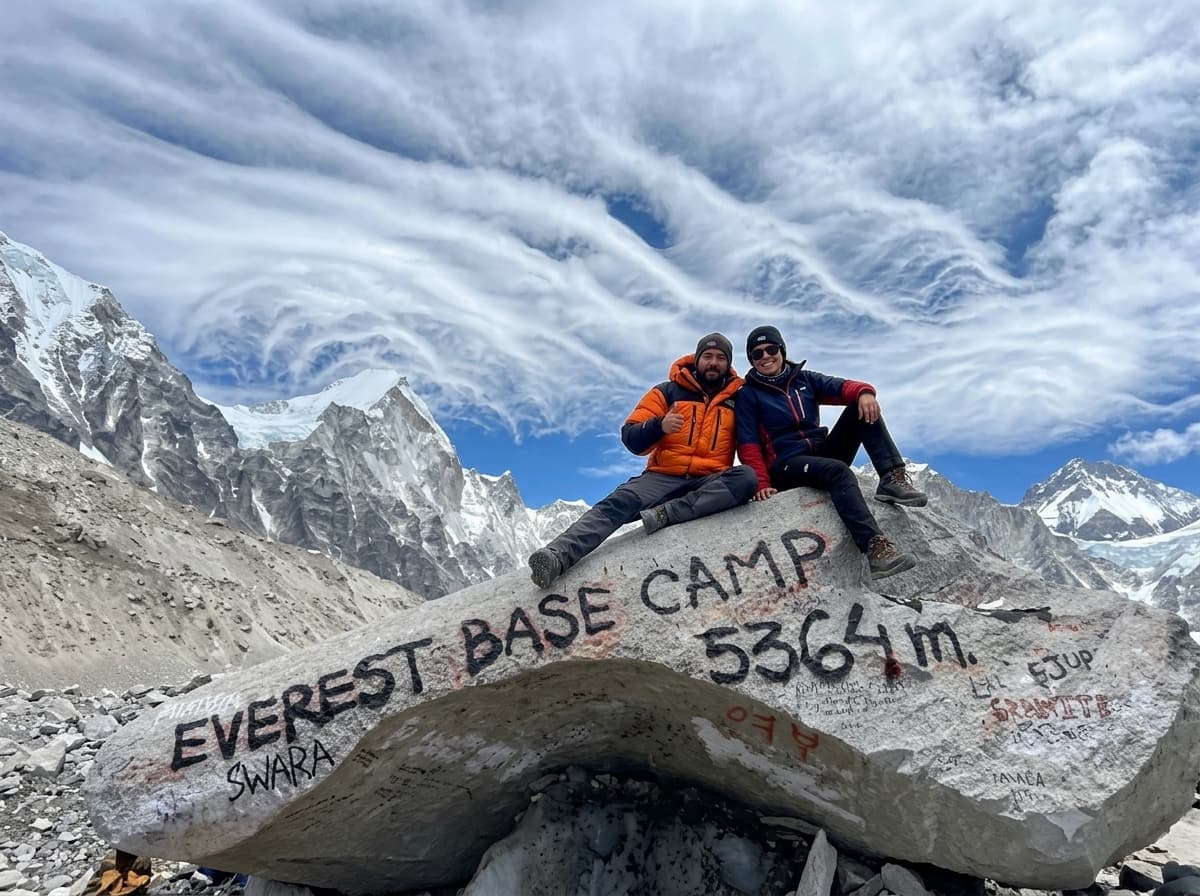
The Annapurna Base Camp trek is generally considered slightly easier than Everest Base Camp because ABC peaks at 4,130 meters versus EBC's 5,364 meters, takes fewer days (10 versus 14), and involves no expensive mountain flights. However, ABC's stone staircases deliver a more intense daily leg workout than EBC's more gradual ascent. Both are rated moderate for reasonably fit trekkers.
Trying to decide between the Annapurna Base Camp trek and the Annapurna Circuit for 2027? When you book with us, our mountain team will match you to the right route based on your fitness, timeline, and mountain experience — not the one with the higher price tag. Contact our team for honest, no-pressure trip planning.